
HAITI | Bukele's War Comes to Haiti: Salvadoran Commandos Hunt Gangs After Four Soldiers Vanish
HAITI | Bukele's War Comes to Haiti: Salvadoran Commandos Hunt Gangs After Four Soldiers Vanish
A Central American strongman who jailed his way to a "gang-free" El Salvador has now sent his special forces into Port-au-Prince's badlands, with a warning the gangs have never heard before — and Jamaican troops are in the same theatre.
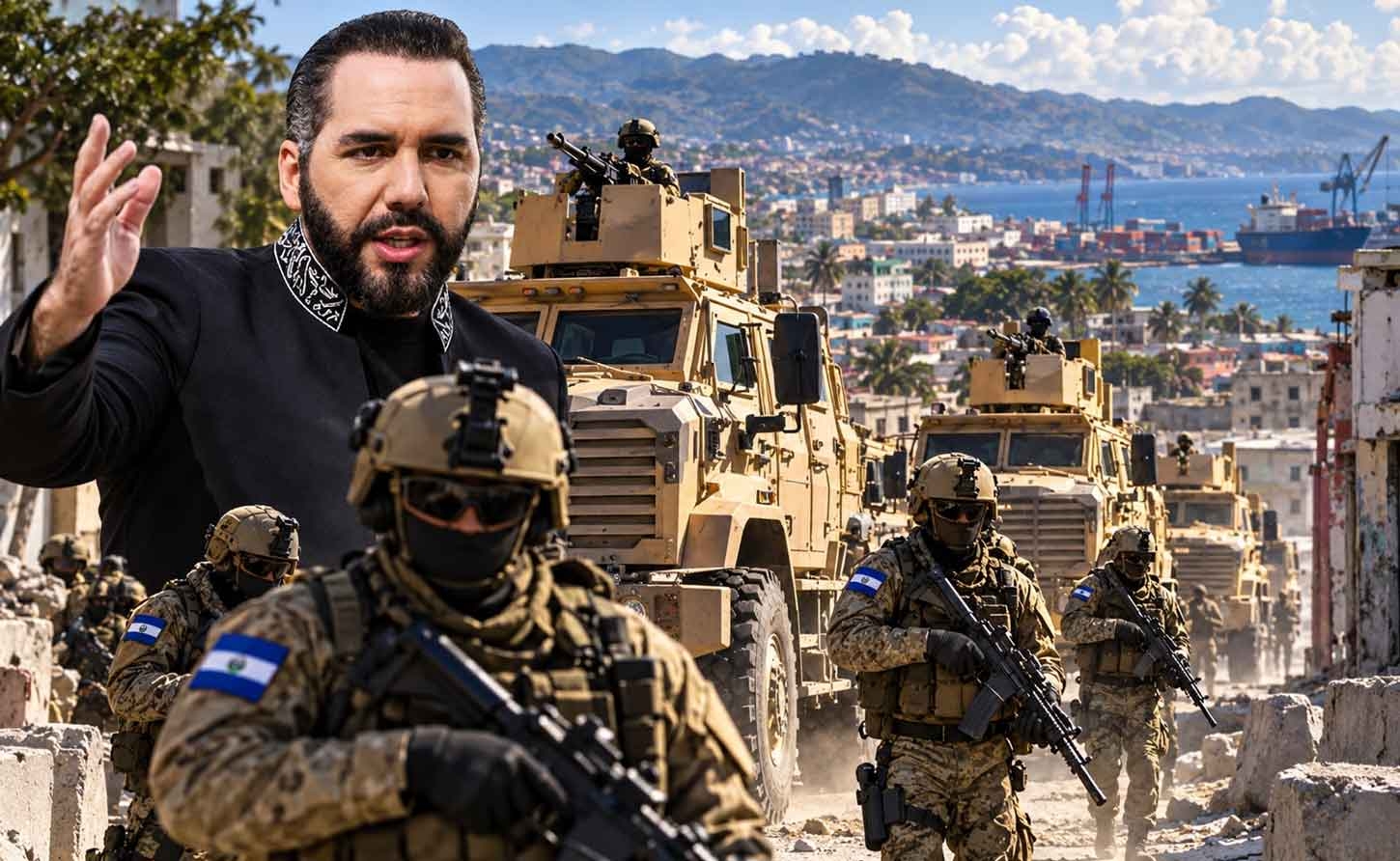
MONTEGO BAY, Jamaica, October 25, 2026 - Calvin G. Brown | Nayib Bukele has brought his war to Haiti. A week after four Salvadoran soldiers disappeared in a hail of gunfire and explosives on the eastern edge of Port-au-Prince, El Salvador has poured as many as 200 special forces troops into the country, and its president has told Haiti's gangs, in so many words, that they are next.
"We have already finished with the gangs in El Salvador, and we can finish with you too," Bukele posted on X on Wednesday, as he announced a military operation to recover the men. "Do not take our word for empty threats."
The four are aviation technicians serving with the UN-backed Gang Suppression Force (GSF), the 5,500-strong mission authorised by the Security Council last year to do what the under-funded Kenyan-led force before it could not.
On Sunday, October 18, their armoured vehicle came under fire in the Santo area of Croix-des-Bouquets. Attackers used explosives. The vehicle burned. The men fled it and have not been seen since.
Haiti's government stayed silent for three days. When it finally spoke on Wednesday evening, it confirmed the four had been abducted, called their release an "absolute priority," and said the prime minister's office had met to decide how to strengthen operations "in close collaboration" with the force.
By then Bukele had already announced his own operation, and Salvadoran officials were telling the Associated Press that 100 commandos had landed on Thursday with another 100 to follow that night.
No gang has claimed responsibility. The territory where the ambush happened is carved up among Chèn Méchan, Kraze Barye, led by Vitel'homme Innocent, and 400 Mawozo, led by Lanmo Sanjou. Both named leaders are under UN and US sanctions. Haitian police and GSF units have been fighting in the area ever since, and residents have been told to stay indoors.
Rescue, or something else?
Strip away the bravado and a hard question remains: under whose authority are Salvadoran commandos now operating in a sovereign Caribbean state?
The legal footing is the GSF mandate. Resolution 2793, renewed last month to March 2027, allows intelligence-led, targeted operations against gangs, and a status-of-forces agreement signed with Haiti in July covers the troops.
El Salvador's own Legislative Assembly passed a decree on September 29 authorising its participation for 12 months. On paper, a rescue mission inside Croix-des-Bouquets fits.
But the GSF has a force commander, Mongolian Major General Erdenebat Batsuuri, and a strategic oversight body. Bukele answers to neither. The mandate also binds every contributor to respect Haiti's sovereignty and to use force that is necessary and proportionate.
Nothing in it licenses a national leader to wage a private campaign of retribution, and a threat to "finish" the gangs sits uneasily beside a legal regime that outlaws collective punishment and demands that captured fighters be treated as prisoners, not examples.
Bukele's record is the reason the threat is taken seriously. His state of exception has put more than 80,000 Salvadorans behind bars since 2022, driven homicides to historic lows, and drawn sustained criticism from human rights groups over mass detention and deaths in custody.
Haitians have watched that model from a distance with something between envy and dread. Now it has arrived on their soil, carried by men with a grievance.
The guns Bukele cannot shoot his way past
There is also a limit to what any commando raid can achieve, and the UN has already spelled it out. The Security Council's own Panel of Experts, in its final report last month, found the arms embargo on Haiti "violated on a regular basis" and identified where the firepower comes from.
Overwhelmingly, it is the United States: rifles and ammunition bought legally, often by straw purchasers using their own names, hidden in barrels of secondhand goods, commercial cargo and shipments labelled as humanitarian aid, then landed in Haiti directly or routed through the Dominican Republic. Barrett .50-calibre anti-materiel rifles have been traced along that road. Washington, the Panel noted, had not answered its weapons-tracing requests.
The rest leaks from state armouries on both sides of the island. Rounds recovered from 400 Mawozo, one of the gangs holding the ground where the Salvadorans were ambushed, carried Dominican Army markings; Dominican police found some 908,000 items, mostly ammunition, missing from their own stocks.
Inside Haiti, 70 per cent of a sample of 7.62mm rounds seized from two gangs came from the Haitian National Police, lost in battle or sold by corrupt officers. A rifle sells in Port-au-Prince for US$5,000 to US$8,000, a bullet for about US$3, and police seized all of 356 firearms in 2025.
Who finances the gangs is less settled. The Panel documents the revenue — ransom kidnapping, extortion on every national road and at the ports, cocaine transiting to Europe — but it names no owners of the shipments, and only nine individuals and two entities sit on the UN sanctions list. El Salvador's special forces may yet recover four men. They will not close a pipeline that begins in a Florida gun shop.
Why Jamaica should be watching
This is not a distant drama. Jamaica is a troop contributor to the GSF alongside El Salvador, Guatemala and Chad, with Jamaican soldiers and police having served in Haiti since the Kenyan-led mission that preceded it. More than 2,000 foreign personnel are now on the ground. The Croix-des-Bouquets ambush is the first major attack on the force since it began operating in April, and it has shown the gangs that an armoured vehicle is not a guarantee of anything.
Kingston has said nothing publicly about the escalation. It should. The rules of engagement that protect Salvadoran technicians protect Jamaican privates too, and a mission in which one contributor goes freelance is a mission in which every contributor's troops become targets for reprisal.
Haiti is meant to hold its first general election in more than a decade. Gangs control roughly 70 per cent of the capital, nearly 1.5 million people have been displaced, and the UN counts more than 5,700 killed or injured between January and mid-September this year. The GSF was supposed to change that arithmetic. Whether it now does so as a disciplined international force, or as the stage for Nayib Bukele's next show of strength, may be decided in the streets of Santo in the coming days.
Four men are still missing. Their government is operating on the assumption that they are alive. The gangs holding them have been told exactly what happens if they are not.
-30-
Sources: AP (via Al Jazeera, Oct 22); AP/Miami Herald (Oct 23 deployment report); Diplomacy & Law analysis (Oct 24); UNSC Res. 2793/2829; UN Panel of Experts on Haiti final report S/2026/714 (Sept 2026) and 2025 reports; ITIA Haiti analysis; Harvard Law IHRC "Disrupting U.S. Arms Trafficking to Haiti"; NBC/DHS reporting on Florida–Haiti gun flows; Wikipedia GSF page. Word count (body, excluding headline/standfirst/sources): ~1,040
