
CARIBBEAN | The King’s Sorrow, Burnham’s £40 Million and the Bill Britain Won’t Pay
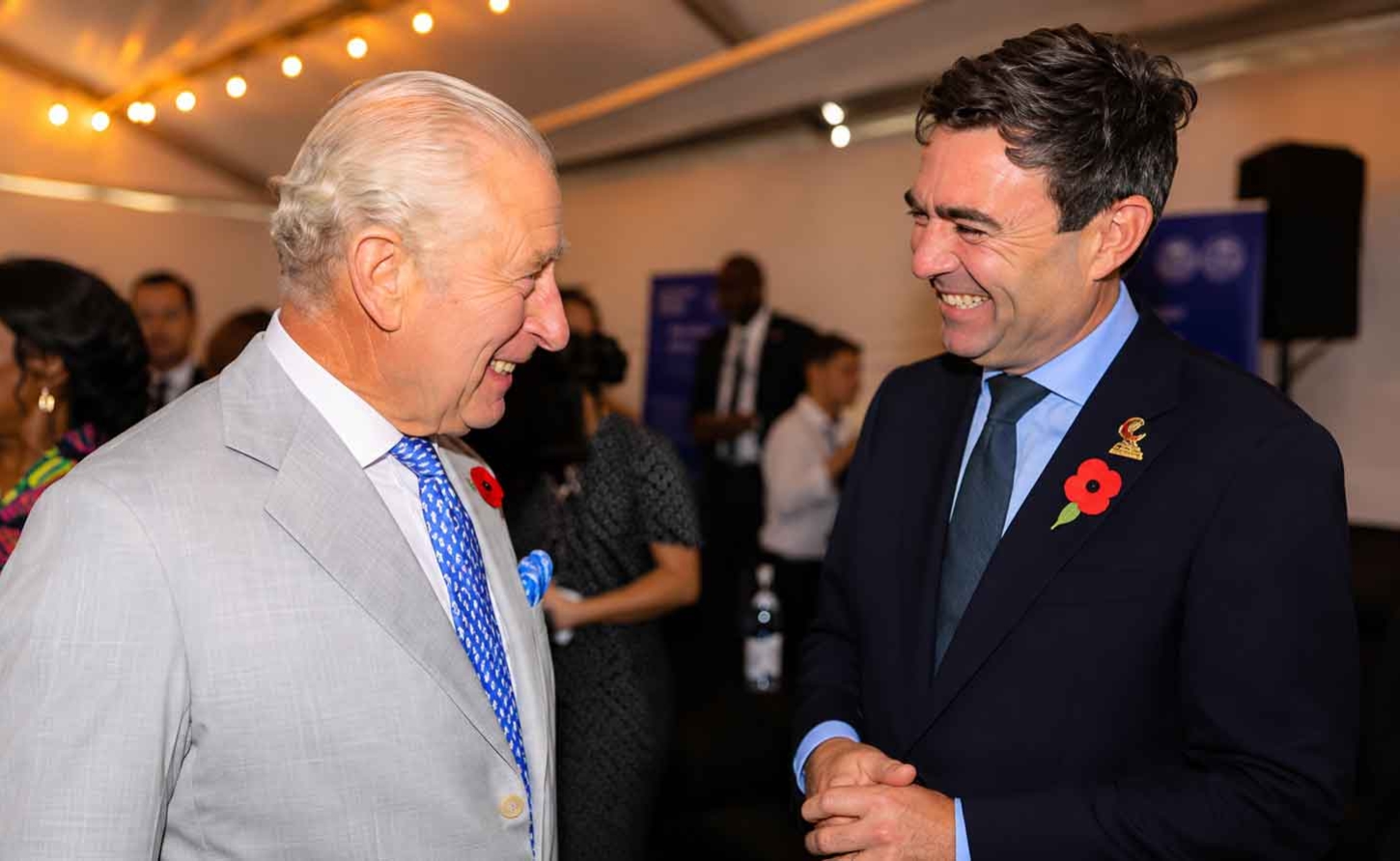
The King and Mr Burnham who has been criticised by opponents who claim that by being open to talks about a formal slavery apology he has put the King under pressure – an accusation denied by the Prime Minister. Picture: Simon Dawson / No 10 Downing Street
King Charles carried horror and heartache to Antigua. Andy Burnham carried £40 million and an open mind. The Caribbean asked for an apology and repair, and came away with a dialogue.
MONTEGO BAY, Jamaica, November 12, 2026 |CALVIN G. BROWN |— King Charles III stood before the leaders of 56 nations in St John’s, Antigua, last Tuesday and told them the transatlantic slave trade fills his heart with “horror” and his soul with “the most profound personal sorrow”. Then he sat down, without the one word the Caribbean has waited centuries to hear.
No apology. No repair. Fifteen minutes of beautifully tailored regret, delivered on an island where enslaved Africans once cut cane for British fortunes, and sealed with a line fit to be carved over the door of every colonial archive: “We cannot change the actions of those who came before us.”
Nobody asked him to change them. They asked him to answer for them.
The art of saying everything but sorry
In fairness, the King cannot freelance. A constitutional monarch speaks on the advice of his ministers, and Buckingham Palace made plain before he landed that no formal apology would be offered on a Caribbean tour that also took him to The Bahamas and Guyana. His role, the Palace said, is about “inspiring and convening, rather than policy making”.
But sorrow has become the Crown’s stock-in-trade. Tony Blair offered “deep sorrow” in 2006. Charles, then Prince of Wales, spoke of his “personal sorrow” in Kigali in 2022. Each time the vocabulary inches closer to contrition and halts precisely where liability might begin.
In Antigua the King even found room to remind his hosts that the Royal Navy played “a leading role” in ending the trade, a curious boast on behalf of a state that spent the better part of two centuries running it. Britain’s own national archives put the number of Africans its ships carried at 3.1 million. Some 400,000 of them never reached the other side.
Nor will the descendants of enslaved Africans forget the role the British Crown itself played in the transatlantic slave trade. When John Hawkins sailed for the West African coast in the 1560s, Elizabeth I invested in his voyages and lent him a royal ship, the Jesus of Lübeck, for the purpose.
A century later, Charles II granted a royal charter to what became the Royal African Company. It was headed by his brother James, Duke of York, the future James II, and historians count it as having shipped more enslaved Africans across the Atlantic than any other single institution in the trade’s history.
So when a King named Charles speaks of the actions of “those who came before us”, the Caribbean knows precisely who came before him.
Outside the hall, a small knot of protesters held placards reading “Acknowledge the wrong. Commit to repair.” Antiguan Shana Michelle told Al Jazeera what the palace speechwriters would not: “You have to apologise, yes. That is where we start with the repair.” Guyana’s President Irfaan Ali was just as direct, saying an apology should be the King’s next step.
Burnham’s half-open door
If the King was bound by protocol, Prime Minister Andy Burnham was bound only by politics, and credit is due: he has gone further than any British premier before him.
Writing in The Guardian days before the summit, he expressed “sorrow and regret for the pain and suffering of so many millions of people”, declared himself open to a formal state apology and offered a “structured dialogue” with the nations that slavery made and maimed. Two years ago in Samoa, Keir Starmer’s Downing Street insisted the subject was not even on the agenda.
Then came the red line. Britons today, Mr Burnham wrote, cannot be “held liable for historical wrongs”. In place of reparations he offered £40 million over three years for Caribbean infrastructure and green energy, drawn, by Downing Street’s own account, from within existing budgets. Alongside it sits a “debt reset”, to be led by former Prime Minister Gordon Brown, giving the poorest Commonwealth countries longer to repay and better rates.
Read that again. The nation that extracted two centuries of unpaid labour is offering the descendants of the enslaved easier terms on what they owe.
Intergenerational liability is a principle Britain honoured faithfully for 182 years. It simply honoured it in one direction.
The loan Britain did not mind repaying
Mr Burnham’s argument, that the living cannot be billed for the sins of the dead, collides with Britain’s own ledger. In 1833 Parliament voted £20 million, roughly 40 per cent of the Treasury’s annual income, to compensate slave owners for the loss of their human “property”.
The enslaved received nothing but years of forced “apprenticeship”. The Treasury borrowed to pay the planters, and that borrowing was not finally retired until February 1, 2015.
British taxpayers alive today, the grandchildren of Windrush among them, helped clear the bill for compensating enslavers. Intergenerational liability, it turns out, is a principle Britain honoured faithfully for 182 years. It simply honoured it in one direction.
That is the point CARICOM’s chairman, Saint Lucia’s Prime Minister Philip J Pierre, pressed home. “Reparatory justice has never been about individual guilt,” he said, adding that an apology without repair is “incomplete”.
Professor Verene Shepherd, vice-chair of the CARICOM Reparations Commission, was sharper still. In an open response published by Al Jazeera, she recalled that when David Cameron rejected reparations in 2015, his counter-offer was £25 million towards a new prison in Jamaica.
She reached back to Sir Arthur Lewis, who wrote in 1939 that the labour stolen from the enslaved was a debt the British “have yet to repay”. And she dismissed rescheduling as a substitute for justice. The region’s demand, she wrote, is debt cancellation and monetary compensation: “It is time for Britain to apologise and pay its debt.”
She also challenged the abolition story the King leaned on. Freedom, she argued, was led by the enslaved themselves, by Chief Takyi in Jamaica and the revolutionaries of Haiti, not gifted by Britain.
The view from Westminster
None of this is cost-free for Mr Burnham at home. Conservative leader Kemi Badenoch branded his overture “navel-gazing”, argued that taxpayers should not pay for events generations before their time, and warned that an apology would hand other countries a reason to demand money.
She asked, too, whether the descendants of African rulers who sold captives would be sent a bill. His opponents further accuse him of putting the King under pressure, a charge he denies. A prime minister who moves an inch on this question pays for it by the yard.
That is a real constraint. It is not a moral argument.
What Antigua actually delivered
The summit closed on November 4 with a communiqué welcoming Britain’s willingness to join a “structured, time-bound, inclusive and good-faith dialogue on reparatory justice”. According to reports of the text, it creates no compensation mechanism and commits no one to pay anything.
Sir Hilary Beckles, who chairs the CARICOM Reparations Commission, called the meeting “the first round of reparations negotiations”. Ralph Gonsalves, the veteran Vincentian statesman, observed that Britain had come to the table “kicking and screaming”.
The Antigua and Barbuda Reparations Support Commission welcomed the progress while noting, drily, that neither a formal apology nor tangible reparations has been secured.
The ground is shifting all the same. In March the United Nations General Assembly, on Ghana’s motion, declared the trafficking and enslavement of Africans the gravest crime against humanity by 123 votes. Every European state abstained. Ghana’s President John Mahama, the African Union’s champion on reparations, came to Antigua with five demands, and a formal apology led the list. Africa and the Caribbean are now reading from the same page.
Take the talks, set the terms
The Caribbean should take the dialogue. It should also refuse to let “time-bound” become a polite word for indefinite. That means a timetable with dates, an apology that comes first and not last, and cancellation, not rescheduling, on the table.
Host Prime Minister Gaston Browne put the stakes plainly: “No nation should be forced to mortgage its future simply to survive its present.” The Caribbean’s present was mortgaged long ago, in counting houses in London, Bristol and Liverpool, by men who were paid in full.
Britain has now spent twenty years refining the language of regret. Deep sorrow. Personal sorrow. Profound personal sorrow. The adjectives multiply; the cheque does not. Sorrow cannot build a hospital in Portland, resurface a road in Hanover or raise a sea wall in Barbuda. It is not a currency, and the Caribbean is done accepting it as payment.
— 30 —
