
JAMAICA | ‘Dem Pepper-Spray Desmond’: Will the King of West Kingston Keep His Crown?
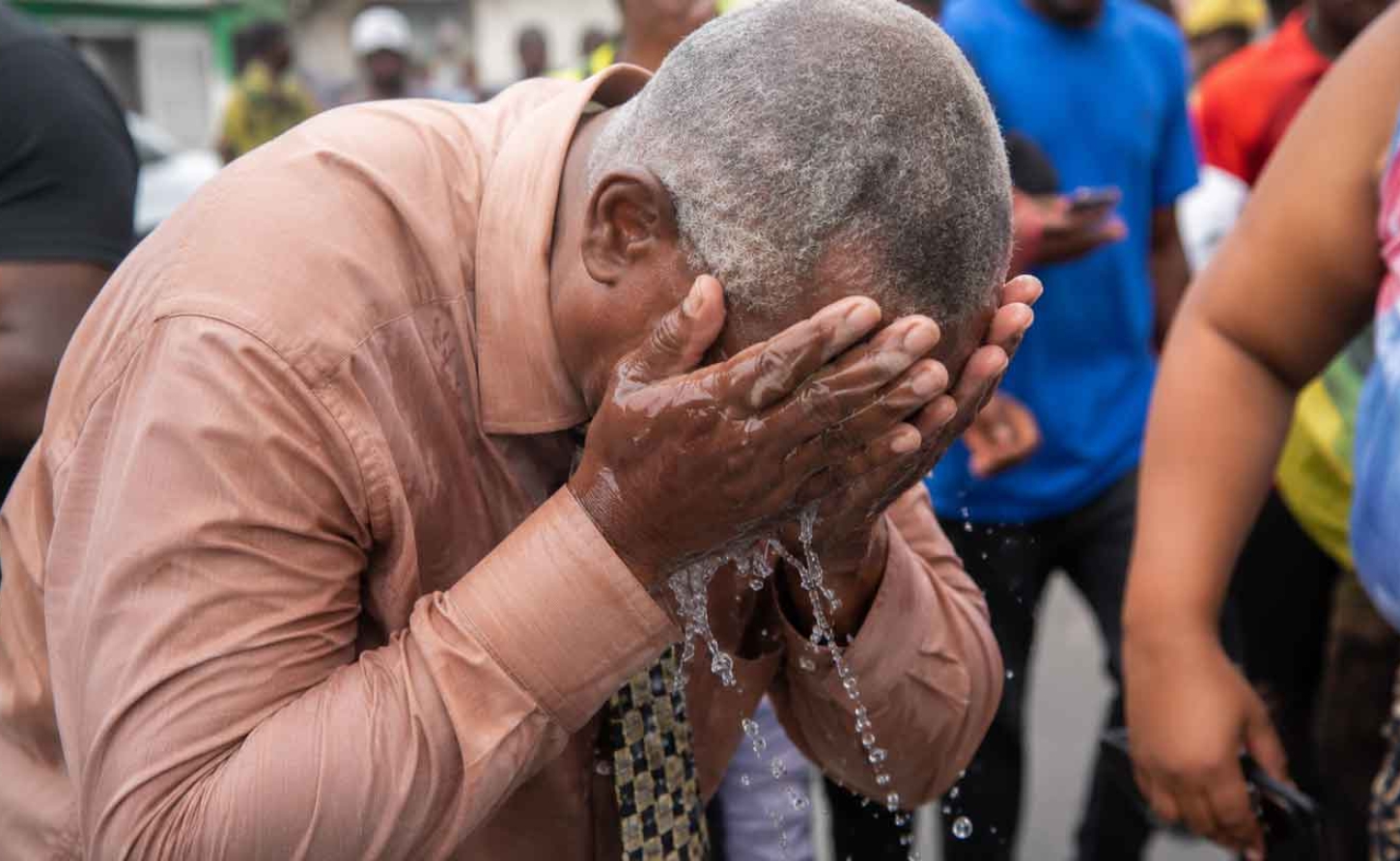
Western Kingston MP Desmond McKenzie washes his face after being pepper sprayed by the polic e in West Kingston on Tuesday.
One burst of pepper spray, a bottle of milk and a mocking street chorus have done what no election defeat ever managed — placed the throne of Jamaica’s most storied political fortress in open question.
KINGSTON, Jamaica, July 15, 2026 - The image of a once-formidable political figure washing pepper spray from his eyes is more than an embarrassing incident. It is a devastating symbol of diminished authority, public resentment and the corrosion of an old political order.
It is a political obituary written in milk, pepper spray and public ridicule.
There stands Desmond McKenzie, once one of the most forceful and seemingly untouchable figures in Jamaica Labour Party politics, bent over and washing pepper spray from his eyes while voices in the background mockingly declare: “Dem pepper-spray Desmond!”
This is not a debate about whether the moment occurred. The video has already fixed the scene in the national consciousness. The issue is the optic. The issue is the political implication. The issue is the fall from grace.
The image is devastating because this is not an obscure backbencher. McKenzie is a senior Cabinet minister, former mayor, veteran political organiser and product of West Kingston—the historic fortress of Jamaica Labour Party power.
Yet the man seen in the video appears far removed from the firebrand of old. The aura of command is gone. The mystique of untouchability has evaporated. In its place is the image of a visibly diminished political veteran rinsing his eyes with milk while bystanders announce his humiliation with mocking disbelief.
No press release can reverse that optic. No official explanation can restore the old image. No partisan defence can erase the symbolism.
THE WEIGHT OF WEST KINGSTON
West Kingston has never been merely another constituency. It is central to the political mythology, organisation and leadership of the Jamaica Labour Party. It has long represented concentrated party power, disciplined loyalty and the intimate connection between political authority and street-level influence.
McKenzie emerged from that tradition. His public persona was built on toughness, command and the conviction that he understood the streets because he came from them. He was not presented as fragile. He was presented as formidable.
That is why the contrast with Christopher “Dudus” Coke is politically unavoidable.
When the State moved against Coke, women in Tivoli Gardens publicly declared that they would die for him. That declaration exposed the dangerous depth of loyalty surrounding the old order. It revealed how power, protection, fear and dependency had combined to create a parallel authority capable of challenging the formal State.
The cry then was: “We will die for Dudus.”
The cry now is mocking: “Dem pepper-spray Desmond!”
That change in language tells the story of political decline. One figure inspired declarations of sacrifice. The other becomes the subject of ridicule. One image projected power so deeply rooted that citizens publicly offered their lives in defence of it.
The other shows a once-formidable political figure bent over, vulnerable, wiping milk from his eyes. This is the fall from untouchability to humiliation. It is the collapse of political mystique. It is the visual unmasking of a man who once appeared to command the streets, the party machinery and the respect—or fear—of those around him.
THE LAUGHTER OF RESENTMENT
The public reaction is as politically significant as the incident itself.
Among the masses who have endured humiliation, rough treatment and unspeakable acts of police brutality, there is likely to be little sympathy. Many will see the moment as bitter irony: a senior representative of a Government widely regarded by its critics as cold and callous now experiencing, however briefly, the force and indignity that ordinary citizens have long complained about.
To those citizens, the scene may feel like divine retribution.
That response should not be dismissed as mere cruelty. It is the product of accumulated resentment. It reflects the anger of people who believe their suffering was ignored because they were poor, powerless and unknown. It is the reaction of those who feel that official concern appears only when the hand of the State touches one of its own.
The laughter is therefore not merely about Desmond McKenzie. It is the laughter of people who believe that power ignored their pain until power itself was made to feel pain. It is the laughter of a public witnessing a reversal of political fortune.
No one should celebrate the misuse of police force. But a Government that wishes to claim the moral authority to condemn public mockery must first confront the reasons why so many citizens feel none of the sympathy that its minister might ordinarily command.
A BLOW TO MCKENZIE, THE JLP AND THE GOVERNMENT
No matter how one looks at it, the image is not good for Desmond McKenzie, the Jamaica Labour Party or the Government.
For McKenzie, it marks a personal fall from grace. The firebrand appears frail. The commanding organiser appears exposed. The man once associated with political protection and street-level authority is seen struggling in public while the crowd mocks rather than rallies.
For the JLP, the moment damages one of the symbols of its historic strength. West Kingston’s mythology has always rested on the appearance of control. The image of one of its most recognisable political heirs being pepper-sprayed and publicly ridiculed punctures that mythology.
For the Government, the optic is even more serious. A senior minister appears not as the embodiment of state authority, but as a victim of it. Whether the episode reflects a breakdown of judgment, discipline, restraint or political influence, none of the possibilities is flattering.
The State looks divided against itself. The minister looks diminished. The party looks unable to protect one of its own most recognisable veterans from public humiliation.
THE IMAGE HAS ALREADY SPOKEN
Political decline is not always announced by an election defeat, a resignation or the formal collapse of a party. Sometimes it is captured in a single unforgettable image.
A once-powerful figure, rooted in the most formidable constituency in JLP history, bends over to wash pepper spray from his eyes. No crowd surrounds him pledging protection. No fortress appears impenetrable. No aura of untouchability remains.
Instead, the mocking refrain rises: “Dem pepper-spray Desmond!”
The incident does not, by itself, prove the death of the Jamaica Labour Party. Political parties do not die from one confrontation. But political obituaries are often written before the formal death—when the symbols of power are emptied of their force, when fear gives way to ridicule, and when those once believed untouchable are exposed as vulnerable.
That is what makes this moment so devastating.
It is not merely an embarrassing incident at a police station. It is a visual statement about age, decline, diminished authority, public anger and the corrosion of an old political order.
It is a political obituary written in milk, pepper spray and public ridicule.
O. Dave Allen |
-30-
O. Dave Allen is a veteran community development advocate and political commentator. The views expressed are those of the author.
